







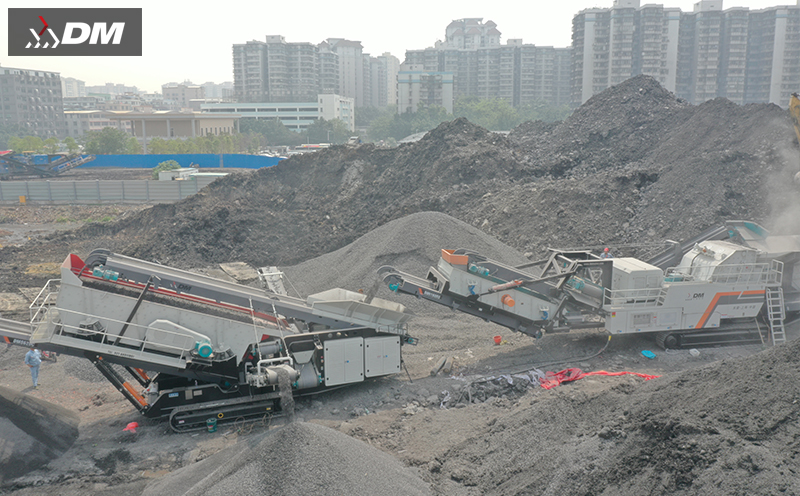
I. Dilemma of Municipal Solid Waste in Uganda: Dual Contradiction Between "Waste Siege" and "Resource Shortage"
With the acceleration of Uganda's urbanization, the population of major cities such as Kampala, Mbarara, and Jinja has grown rapidly, and the annual output of municipal solid waste (including construction waste, domestic waste, and commercial waste) has increased at a rate of 10%-15%. The traditional treatment method is mainly open-pit landfilling, which not only occupies a large amount of land (more than 50 mu of new landfills are added around Kampala every year) but also easily causes soil pollution and groundwater leakage, exacerbating environmental pressure; at the same time, Uganda's infrastructure projects (highways, affordable housing, commercial buildings) are advancing continuously, leading to a surge in demand for construction aggregates. Some areas need to purchase aggregates from hundreds of kilometers away, resulting in high costs and unstable supply.
This dual contradiction between "difficult waste treatment" and "lack of aggregate sources" has become a key issue restricting Uganda's urban development—大量 solid waste is discarded as "waste", while infrastructure faces a "resource gap". There is no effective conversion channel between the two, creating a vicious cycle of resource waste and rising development costs.
II. Municipal Solid Waste Sorting and Crushing Production Line: Building a Full-Link Transformation of "Sorting-Crushing-Regeneration"
Targeting the characteristics of Uganda's municipal solid waste, the municipal solid waste sorting and crushing production line focuses on "resource regeneration" and realizes the conversion of various solid wastes into usable resources through the integrated design of "intelligent sorting + precise crushing". Its core functions are reflected in three key links:
1. Intelligent Sorting: Precise Separation to Screen Recyclable Resources
The front end of the production line is equipped with an intelligent sorting system, which realizes efficient classification of solid waste through dual technologies of "physical screening + sensor identification":
- Preliminary screening: Vibrating screens and drum screens are used to separate "bulk materials" (such as bricks, concrete blocks in construction waste) and "small debris" (such as plastic, paper in domestic waste) according to material particle size, preventing bulk materials from blocking subsequent equipment;
- Intelligent identification: When small materials enter the belt conveying link, metal sensors automatically identify and absorb metal impurities such as iron and aluminum (such as steel bars in construction waste, cans in domestic waste), and separate and recycle them through magnetic suction devices; optical sensors identify light materials such as plastic and cloth, and sort them into dedicated recycling channels through air blowing devices;
- Manual assistance: A manual sorting platform is set up to conduct secondary sorting of special materials (such as glass, rubber) not identified by sensors, ensuring sorting purity and laying the foundation for subsequent crushing and regeneration.
The classification efficiency of this sorting system is over 90%, which can accurately separate recyclable resources (metal, plastic) and crushable renewable materials (bricks, concrete) in solid waste, avoiding resource mixing and waste.
2. Precise Crushing: On-Demand Processing to Convert into Usable Raw Materials
The "crushable materials" (mainly bricks, concrete blocks, and a small amount of hard domestic waste) after sorting enter the core crushing link of the production line, and realize "on-demand conversion" through the graded crushing module:
- Primary crushing: A jaw crusher is used for preliminary crushing of large bricks and concrete blocks, reducing the particle size from more than 1 meter to 30-50 cm, breaking the material structure and facilitating subsequent fine processing;
- Fine crushing and shaping: The primarily crushed materials enter the impact crushing module, and through high-speed impact and grinding, the materials are crushed to the particle size meeting Uganda's infrastructure standards (5-30 mm). At the same time, the aggregates are "shaped" to make their particle shape rounder and gradation more uniform, meeting the needs of different scenarios such as road base laying and concrete pouring;
- Anti-blocking design: Aiming at flexible materials that may remain in domestic waste (such as cloth strips, plastic bags), the crushing chamber is equipped with an "anti-tangling device", which cuts off flexible impurities through rotating blades to prevent equipment blockage and ensure the continuous operation of the production line.
Compared with traditional crushing equipment, the crushing module of this production line is optimized for the characteristics of "mixed solid waste". It can handle hard bricks and stones and cope with a small amount of impurities without prior manual cleaning, greatly improving processing efficiency.
3. Resource Regeneration: Classified Output to Match Application Scenarios
At the end of the production line, the crushed materials and sorted recyclable resources are output in categories through the screening and conveying system, realizing "one waste for multiple uses":
- Recycled aggregates: The crushed brick and concrete particles are graded through vibrating screens and divided into "coarse aggregates" (20-30 mm, used for road base laying) and "fine aggregates" (5-20 mm, used for concrete mixing and wall masonry) according to particle size, which are directly supplied to surrounding projects as infrastructure raw materials;
- Recycled resources: The sorted metals (iron, aluminum) can be directly sold to waste recycling enterprises, and plastics can be compressed and packed before being transported to processing plants to make recycled plastic particles;
- Residual waste: After sorting and crushing, only a small amount of non-renewable materials (such as rotting organic matter and difficult-to-treat rubber) remain, and their volume has been reduced by more than 70%, which can reduce the amount of landfilling and lower subsequent treatment costs.
This "classified output" model transforms Uganda's municipal solid waste from "single waste" into "diversified resources", directly connecting to infrastructure and recycling markets to form a closed-loop conversion.
III. Practical Value: A Case of "Resource Revolution" in Ugandan Cities
After a waste treatment plant in Kampala introduced a set of municipal solid waste sorting and crushing production lines, significant benefits were achieved in only 3 months, becoming a typical case of "waste-to-resource" in Uganda:
- Processing capacity: It handles 200 tons of municipal solid waste per day, including 150 tons of crushable materials and 50 tons of recyclable and residual waste;
- Resource conversion: It produces 3,000 tons of recycled coarse aggregates and 1,500 tons of fine aggregates per month, all supplied to the suburban highway reconstruction project in Kampala, saving 40% of the project's aggregate procurement cost; it recycles 5 tons of metal and 3 tons of plastic per month, which are sold to local recycling enterprises, generating an additional monthly income of approximately $5,000;
- Environmental benefits: The amount of solid waste landfilled has decreased from 200 tons per day to 60 tons, reducing landfilling area by 70%, and the risk of soil and groundwater pollution in the surrounding area has been significantly reduced;
- Operating cost: The production line adopts automatic control, and only 6 operators are needed to complete the whole process operation. Compared with the traditional "manual sorting + decentralized crushing" model, the labor cost is reduced by 60%, and the operation stability is higher.
The person in charge of the treatment plant said: "In the past, we had to transport a large amount of garbage to landfills every day. Now these 'garbages' have become aggregates and metals that can be sold for money. We not only make money but also help the city solve environmental problems, which was unimaginable before."
IV. Operation Optimization Suggestions for the Production Line in Uganda
To give full play to the "resource conversion" value of the production line, combined with the characteristics of Uganda's municipal solid waste and operating environment, the following strategies are recommended:
- Material adaptation: Adjust the parameters of the sorting system (such as sensor sensitivity, screening particle size) and the configuration of the crushing module (such as primary crushing gap, fine crushing speed) according to the composition of solid waste in different cities (e.g., high proportion of construction waste in Kampala, high proportion of domestic waste in Mbarara) to ensure adaptation to local materials;
- Supply connection: Sign recycled aggregate supply agreements with surrounding infrastructure projects (such as municipal roads, real estate projects) in advance to establish stable sales channels and avoid backlog of recycled resources; cooperate with local waste recycling enterprises to ensure timely monetization of recyclable resources such as metals and plastics;
- Maintenance guarantee: Uganda has heavy rains in the rainy season, so it is necessary to install waterproof covers for the electrical equipment of the production line (such as sensors, control systems) and conduct anti-rust treatment for open-air equipment such as belt conveyors; regularly clean the crushing chamber and screening devices to avoid material adhesion affecting efficiency.
Conclusion
Against the background of Uganda's urban development facing "solid waste pressure" and "resource gap", the municipal solid waste sorting and crushing production line is not only a "waste treatment equipment" but also a conversion bridge connecting "waste" and "resources"—it converts municipal solid waste that was originally discarded into aggregates and recyclable resources urgently needed for infrastructure, solving the problem of solid waste pollution and reducing infrastructure costs, and realizing dual benefits of "environmental protection" and "economy".
From the practice in Kampala, this production line provides a feasible "waste-to-resource" solution for Uganda. It can not only alleviate the resource contradiction in urban development but also promote the formation of an urban development model of "circular utilization", injecting green and efficient new impetus into Uganda's urbanization process.
If you would like to get help immediately, you can also fill your requirements on the following form, we will contact you on the right time.


Get In Touch